
Liquid and Paste Filling Machine Guide for Malaysian Businesses
Packaging plays an important role in manufacturing because it protects products, improves presentation, and helps businesses deliver consistent quantities to customers. For companies handling liquids and thick products, choosing the right filling equipment can make the packaging process faster and more organised. Two commonly used solutions are the liquid filling machine and paste filling machine.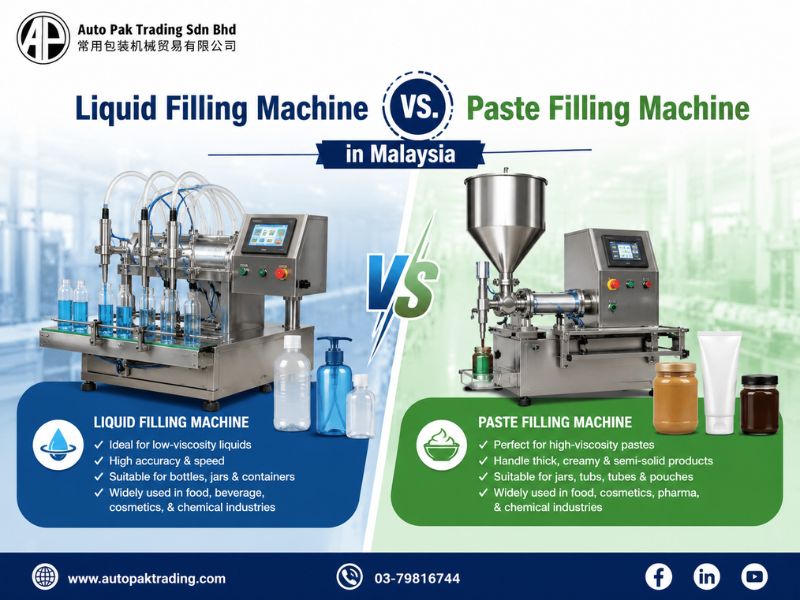
These machines are designed for different product consistencies and applications. Understanding how they work and what factors to consider can help businesses select equipment that matches their production requirements.
What Is a Liquid Filling Machine?
A liquid filling machine is packaging equipment used to dispense liquid products into bottles, containers, jars, or other packaging formats. Instead of relying entirely on manual filling, businesses can use filling machinery to achieve more consistent quantities and improve production efficiency.
Liquid filling machines can be suitable for various products, depending on their formulation and viscosity. Examples may include oils, sauces, beverages, detergents, cleaning products, and other liquid-based products.
For businesses handling regular production volumes, using a filling machine can simplify repetitive filling tasks and create a more consistent packaging process.
Why Is a Liquid Filling Machine Useful?
Manual filling may work for small-scale production, but it can become difficult to maintain consistency as production increases. A liquid filling machine can help address some of these challenges.
One important advantage is filling consistency. When every container needs to receive a similar quantity, controlled filling equipment can help reduce variations between containers.
A filling machine can also help improve workflow. Instead of manually measuring and transferring every quantity, operators can use the machine to streamline the filling stage.
Another benefit is reduced product wastage. Better control over filling quantities can help businesses avoid unnecessary overfilling, although the actual level of accuracy depends on the machine, product, and operating conditions.
What Is a Paste Filling Machine?
A paste filling machine is designed for thicker and more viscous products. Unlike thin liquids that can flow easily, pastes and semi-solid products may require different dispensing mechanisms.
Products that may require paste filling equipment include sauces, creams, gels, cosmetic products, food pastes, and other viscous materials.
The purpose of a paste filling machine is to provide controlled dispensing while handling products that are more difficult to transfer than ordinary liquids.
For manufacturers working with thick products, using equipment specifically designed for viscosity can make the filling process more practical and consistent.
Liquid Filling Machine vs Paste Filling Machine
Although both machines are used to fill containers, they are not necessarily designed for the same products.
A liquid filling machine is generally associated with products that flow relatively easily. Depending on the machine design, it can be used for a variety of liquid products.
A paste filling machine, on the other hand, is intended for products with higher viscosity. Thick sauces, creams, gels, and pastes may require equipment capable of handling their consistency.
The best option depends on the actual product rather than simply the packaging container. Before choosing equipment, businesses should consider viscosity, filling volume, container design, production speed, and other operational requirements.
Important Factors to Consider Before Buying Filling Equipment
Choosing filling equipment should be based on several practical considerations.
1. Product Consistency
First, determine whether the product is thin, medium-viscosity, or thick. Product consistency can influence which type of filling mechanism is appropriate.
For example, a free-flowing liquid may require a different solution from a thick cream or paste.
2. Filling Quantity
Businesses should determine the amount of product required in each container. Different products and packaging formats may require different filling ranges.
Understanding the required quantity before purchasing equipment can help businesses choose a machine that fits their application.
3. Container Size and Shape
The type of container can also affect the filling process. Bottles, jars, containers, and other packaging formats may have different opening sizes and shapes.
The filling equipment should be compatible with the containers being used during production.
4. Production Volume
A small business with limited production requirements may have different machinery needs from a manufacturer handling large volumes every day.
Businesses should consider both current production requirements and possible future growth when selecting a liquid filling machine or paste filling machine.
5. Ease of Operation
Operators need to work with the machine regularly, so straightforward operation and practical controls can be important considerations. Businesses should also consider cleaning and maintenance requirements.
Common Applications of Liquid Filling Equipment
A liquid filling machine can have applications across multiple industries.
In the food industry, filling equipment can be used for products such as cooking oils, sauces, syrups, and other liquid food products.
Cleaning and chemical manufacturers may also require filling machinery for detergents and other liquid formulations.
The pharmaceutical, cosmetic, and personal care industries can have their own filling requirements depending on the formulation and packaging format.
The machine configuration should always be selected according to the specific product and production process.
Common Applications of Paste Filling Equipment
A paste filling machine is useful when products have a thicker consistency.
Food manufacturers may use this type of equipment for sauces, pastes, spreads, and similar products. Cosmetic manufacturers may require paste filling solutions for creams, gels, and other personal care formulations.
Industrial manufacturers may also work with products that require controlled filling because of their viscosity.
Using an appropriate filling solution can help create a more organised production process and consistent packaging results.
How Filling Machines Can Improve Packaging Efficiency
One of the main reasons businesses consider filling equipment is to improve production efficiency.
When filling is performed manually, workers may need to repeatedly measure and transfer products into containers. This can consume time, particularly when production quantities increase.
A suitable liquid filling machine or paste filling machine can streamline this repetitive stage of packaging.
However, machine selection should not focus only on speed. Filling consistency, product compatibility, cleaning requirements, container compatibility, and overall workflow are equally important.
Choosing a Suitable Packaging Machinery Supplier
Selecting the right machinery supplier is another important part of the purchasing process. Businesses should provide information about their product, container, filling quantity, and expected production volume.
A supplier can then better understand the application and suggest suitable equipment.
Auto Pak Trading provides packaging machinery solutions for businesses in Malaysia. Companies looking for filling equipment can discuss their specific requirements with the team before selecting a suitable machine.
Whether the requirement involves a liquid filling machine for liquid products or a paste filling machine for thicker formulations, understanding the application is an important first step.
Final Thoughts
Filling is an important stage of the packaging process, and the right equipment can help businesses improve consistency and streamline production. A liquid filling machine can be useful for a variety of liquid products, while a paste filling machine is designed to handle thicker and more viscous formulations.
Before investing in filling equipment, businesses should consider product consistency, filling quantity, container type, production volume, operation, and maintenance requirements.
For businesses in Malaysia exploring packaging and filling machinery, Auto Pak Trading can be contacted to discuss specific requirements and available solutions.
Contact Auto Pak Trading
Email: autopak_trading@yahoo.com
Phone: 03-79816744
Address: 6-0-14 Meadow Park, Jalan 1/130, (5 Mile off Jalan Klang Lama), 58200 Kuala Lumpur